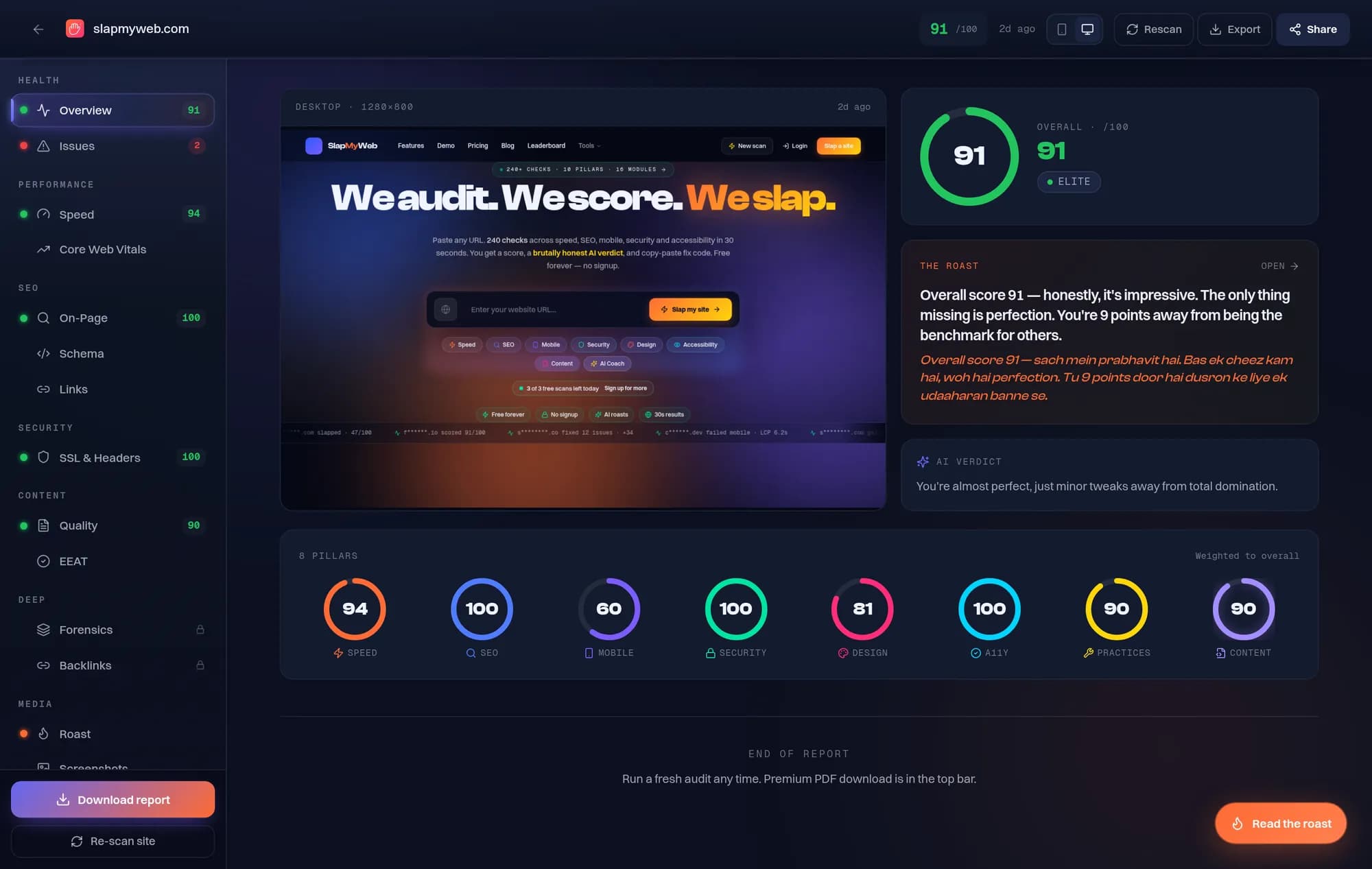
Looking for a SeOptimer alternative? SlapMyWeb runs 240+ checks with AI search readiness, accessibility and copy-paste fix code — from $9/mo. Free instant audit, no signup.
240+ checksFrom $9/moFree to start
532 sites scanned · average score 70
The closest alternative to SEOptimer depends on which half of it you use. For branded client reports, SEOptimer is still strong. For audit depth and actually fixing what is found, SlapMyWeb runs 240+ checks including accessibility, security and AI search readiness, and generates the fix code — at $9/month against SEOptimer's ~$29 entry plan.
Why teams switch
Everything SeOptimer does — and the parts it skips.
SeOptimer is a solid, mature audit-and-report tool. SlapMyWeb is built for the next job: the deeper scan, the AI-search layer, and the code that actually fixes what’s found.
Reason 1
A deeper audit
SeOptimer grades the established fundamentals well. SlapMyWeb runs 240+ checks across 10 audit areas — adding crawl-budget, structured-data validation, international SEO, authority signals and more that a standard on-page audit doesn’t reach.
What the scan returns
Overall
On-page SEO74
Performance48
AI search31
240+ checks vs a standard on-page audit
Crawl, indexation and log-level forensics
Full schema.org validation per @type
Reason 2
The fix, not just the flag
The biggest day-to-day difference: SeOptimer tells you what’s wrong; SlapMyWeb generates the code to fix it. Meta tags, schema JSON-LD, redirects, image markup — paste and ship.
Copy-paste fix code per issue
AI plain-English verdicts, not warning dumps
Impact-ranked action plan — what to fix first
Optional savage roast to make the report land
Reason 3
Built for AI search
SeOptimer only recently added AI features. SlapMyWeb scores AI search readiness natively — whether ChatGPT, Perplexity, Gemini and Google AI Overviews can crawl, parse and cite you. That’s where 2026 traffic is moving.
AI crawler access across 6 engines
Citable content structure for AI Overviews
AI-friendly schema (FAQ, HowTo, Article)
Plus accessibility (WCAG 2.2 AA) and security audits
Reason 4
A cheaper way in
SeOptimer’s paid plans start around $29/mo. SlapMyWeb’s Pro is $9/mo with full fix code, keyword research and rank tracking, and Agency is $29/mo with white-label, multi-client workspaces, bulk scan and backlinks — more at the same price.
Pro $9/mo — roughly a third of SeOptimer’s entry
Free tier: 10 scans/day, full issue list
Agency $29/mo: white-label + multi-client + bulk
3 anonymous scans/day with no signup at all
Side by side
SlapMyWeb vs SeOptimer
Feature
SlapMyWeb
SeOptimer
Checks run
240+ across 10 audit areas
100+ data points
Copy-paste fix code
Yes
No
AI search readiness (GEO)
Native — 6 engines
Recently added
Accessibility (WCAG 2.2 AA)
Yes — axe-core
No
Security & compliance audit
Yes
Basic
Conversion / UX audit
Yes
No
White-label reports
Agency $29/mo
From ~$29/mo
Embeddable lead-gen widget
Yes
Yes
Keyword research
Pro $9/mo
Included on paid plans
Rank tracking
Pro $9/mo
Included on paid plans
Backlink analytics
Agency $29/mo
Basic data inside audits
Multi-client workspaces
Agency $29/mo
Multi-client report management
API access
Enterprise $99/mo
Higher plans
Entry paid price
$9/mo Pro
$29/mo
Free instant audit, no signup
Yes
Email gate
The long version
How the two tools actually differ
Market positioning
SEOptimer and SlapMyWeb occupy the same broad space — point a tool at a URL, get an SEO report — but they aim at different jobs. SEOptimer built its reputation on white-label reporting: agencies run an audit, put their own logo on a clean PDF, and send it to a client or prospect. Its embeddable audit widget extends that into lead generation. SlapMyWeb positions itself as an audit engine first: the core promise is depth — 240+ checks, scored across 8 pillars and covering 10 audit areas — plus an AI layer that turns findings into plain-English verdicts and generates the fix code. White-label and multi-client workspaces exist on the Agency tier, but they sit on top of the audit engine rather than being the headline. Think of SEOptimer as a reporting tool with an audit inside, and SlapMyWeb as an audit and remediation tool with reporting on top. Which framing matters depends on whether your bottleneck is producing reports or actually fixing sites.
Audit and feature depth
SEOptimer covers the established fundamentals: on-page SEO, usability, performance, social presence and basic security. It is deliberately scoped so a non-technical reader can absorb the whole report in a few minutes. SlapMyWeb goes wider: 240+ checks spanning crawl and indexation, on-page, content quality, link architecture, mobile UX, Core Web Vitals, structured-data validation, international SEO, authority signals and AI search readiness. Several of those have no equivalent in SEOptimer — GEO scoring (how visible you are to ChatGPT and Perplexity-style engines), WCAG 2.2 AA accessibility auditing via axe-core, and dedicated security and compliance checks. The other structural difference is remediation: SEOptimer tells you what is wrong and recommends what to do; SlapMyWeb generates the fix code, which collapses the gap between reading the report and shipping the change. The tradeoff is real, though — a tighter report is easier to hand to a client, and SEOptimer has had years to tune its checks against real-world sites.
Pricing and value
SEOptimer’s paid plans start around $29/mo, and that entry tier already includes white-label reporting — historically one of the cheapest ways for a small agency to get branded audit PDFs. SlapMyWeb’s ladder starts lower: anonymous visitors get 3 scans a day with no signup, a free account gives 10 scans a day with the full issue list and a branded PDF, Pro is $9/mo and unlocks full fix code, keyword research and rank tracking, and Agency at $29/mo adds white-label, multi-client workspaces, bulk scanning and backlink analytics. At the same ~$29 price point SlapMyWeb bundles more, while SEOptimer’s strength there is polished report customisation. For a freelancer or in-house marketer who needs deep audits and fixes, $9 Pro is the cheaper path; for an agency whose deliverable is the branded report itself, the two land at a similar monthly cost and the decision comes down to features rather than price.
Who each tool serves
SEOptimer serves agencies and consultants whose workflow revolves around client communication: run an audit, brand the PDF, send it, win or retain the account. Its multi-language reports suit agencies with international clients. SlapMyWeb serves the people who have to fix the site — developers, technical marketers and agencies that deliver implementation, not just reports. Fix-code generation, the accessibility and security modules and GEO scoring are aimed at teams that treat an audit as a work queue rather than a sales document. The Agency tier covers white-label and multi-client too, but the product assumes you will act on findings. One honest caveat: SlapMyWeb launched in 2026, so its integrations ecosystem is smaller and there is no decade-long archive of community answers behind it. SEOptimer has that today.
The bottom line
These tools overlap enough that most buyers should pick one, not both. Choose SEOptimer if your core deliverable is the report: a mature, well-liked tool whose white-label PDFs and multi-language support are genuinely good at turning audits into client conversations. Choose SlapMyWeb if your core deliverable is the fix: deeper coverage including accessibility, security and AI search readiness, AI verdicts that prioritise the work, and generated fix code that shortens the path from finding to deploy — at $9/mo for Pro against ~$29/mo for SEOptimer’s entry paid plan. Agencies sit in the middle: if you mostly sell audits, SEOptimer’s reporting polish wins; if you sell implementation and want one tool that audits, prioritises and hands your developers code, SlapMyWeb’s Agency tier at the same ~$29 is the stronger bundle. Try the free tier first — 10 scans a day with the full issue list costs nothing and tells you quickly whether the extra depth matters for your sites.
The verdict
So which one should you pick?
Pick SlapMyWeb if…
You need audit depth and remediation: 240+ checks including accessibility, security and AI search readiness, with generated fix code and a prioritised plan. It is also the cheaper route to keyword research and rank tracking at $9/mo, and the $29 Agency tier bundles white-label, multi-client workspaces, bulk scanning and backlinks.
Pick SEOptimer if…
Your business runs on branded client reports. Its white-label PDFs are polished and support multiple languages at the entry paid price, and as a long-established product it carries less new-tool risk — a larger community, more third-party tutorials and a decade of tuning behind its checks.
How it works
Switch in 30 seconds
1
Paste your URL
No signup, no migration, no card. Run the same audit you’d run in SeOptimer — instantly.
2
Compare the depth
See the extra pillars, the AI-search score, and the fix code SeOptimer doesn’t give you.
3
Keep what works
White-label reports and multi-client workspaces are on Agency — so you lose nothing you relied on.
FAQ
Questions, answered straight
Yes — especially if your priority is audit depth and actually fixing issues rather than only producing branded reports. SlapMyWeb runs 240+ checks (including accessibility, security and AI search readiness) and generates copy-paste fix code for what it finds. If white-label reporting is your single most important feature, SeOptimer is still strong, but SlapMyWeb matches it on the Agency tier while going deeper on the audit itself.
Yes. SlapMyWeb gives you a full audit — every issue, the 0–100 score and a prioritised action plan — free with no signup. A free account adds 30-day history and a branded PDF. That’s more generous than SeOptimer’s limited free audit, which gates the full report behind an email or trial.
SeOptimer’s paid plans start around $29/mo. SlapMyWeb’s Pro is $9/mo with full fix code, keyword research and rank tracking, and at the same $29/mo price point SlapMyWeb’s Agency tier bundles white-label, multi-client workspaces, bulk scanning and backlink analytics.
SeOptimer is a longer-established product with a larger community, a bigger third-party tutorial ecosystem and multi-language white-label reports at its entry price. Both tools now offer an embeddable lead-gen audit widget. If a decade of maturity and community answers matters most to you, that’s SeOptimer’s edge today.
The other tools most often compared to SeOptimer are WooRank, Sitechecker, SE Ranking and Semrush’s Site Audit. WooRank and Sitechecker are closest in spirit (single-URL audit + reporting); SE Ranking and Semrush are broader, pricier all-in-one SEO suites. We publish honest head-to-head pages for each — see /vs/woorank, /vs/sitechecker, /vs/se-ranking and /vs/semrush.
Yes, both include rank tracking on their paid plans. SlapMyWeb puts keyword research and rank tracking on Pro at $9/mo; SEOptimer includes them on its paid tiers from around $29/mo. If rank tracking is the main thing you are buying, SlapMyWeb is the cheaper entry point; if you also want the polished white-label report around it, the tiers are closer than the headline prices suggest.
Two, honestly. SlapMyWeb launched in 2026, so there is no decade of community answers, third-party tutorials or integrations behind it the way there is for SEOptimer. And SEOptimer’s white-label PDF customisation is more mature, including multi-language reports at its entry price. If your deliverable is the document itself rather than the fix, that gap is real.
No. There’s nothing to migrate — SlapMyWeb audits from the URL with no plugin, no DNS record and no verification. Paste your site (or a client’s) and you’ll have a full audit in about 30 seconds.